
General Principles of Machine Learning
Think of a machine learning model like a "consultant" to which you give your experiment results. It analyses it, finds the underlying trends, correlations, sensitivities, etc. Once it has acquired enough data, you can then ask it what it thinks of potential new experiments for which you don't yet have results. It uses the data and understanding it acquired to tell you what it expects as a results.
The most basic machine learning model family is linear regression: you have a set of experiments results (a scatter of data points), you construct a line that passes through them, one that has the least cumulative distance to all of the points, and you consider that unknown experiment results fall on that line.
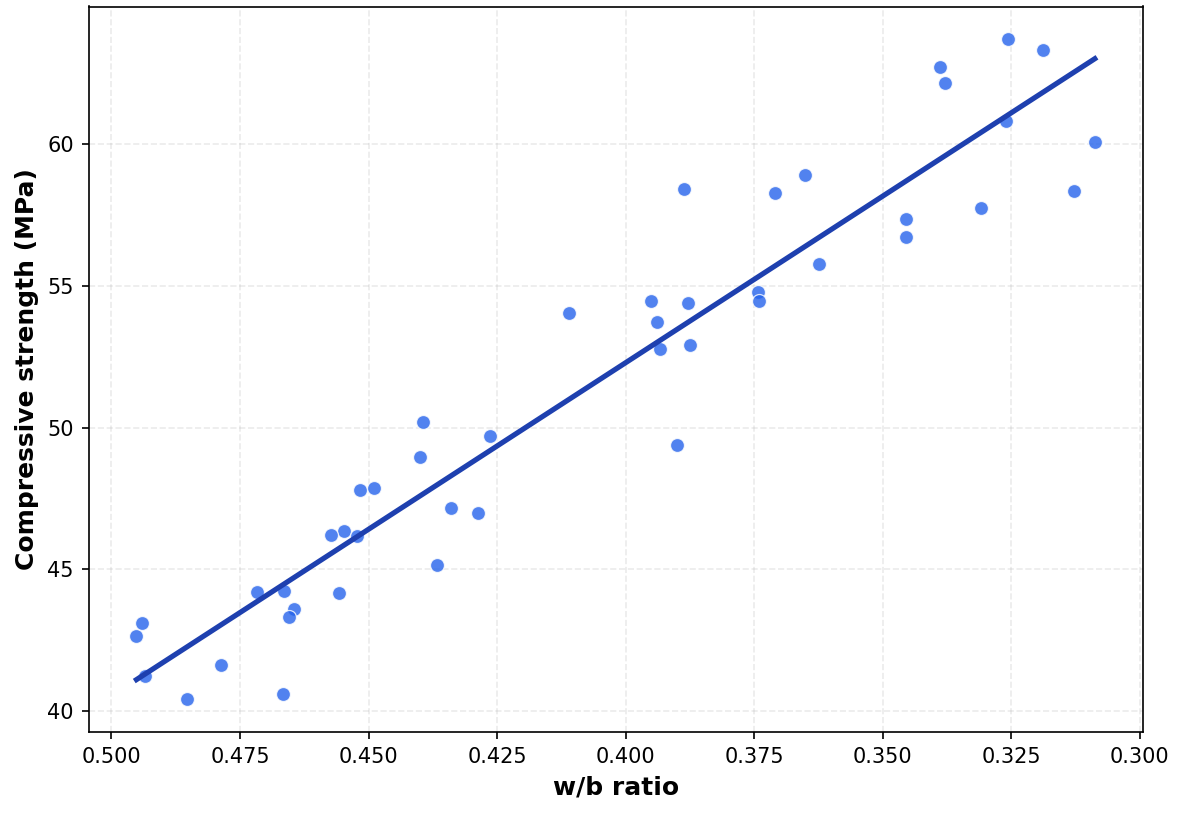
The model here is the line you have constructed. One can think why not a hyperbole? a logarithm or exponential function? These are very relevant questions.
Some people say that model building is more of an art that it is a science. There is no general rule for deciding which model to go with in what case. It all depends on the evaluation of the statistician. In some cases, linear models are more than enough. In others, they are not.
Uncertainty of predictions
Let's say you have built a linear regression model. When you predict some outcome using your model, you get a result. But you don't know how certain that specific prediction is.
The most you can get is an mean-squared error, which tells about the overall quality of the model, not the error of a specific
Some of the quite advanced machine learning model families work like this, they give you averall quality measures, but not the uncertainty of a single prediction. eg. Random Forest, Neural Networks, etc.
However, there are some non-parametric model families that do. That is, each prediction comes with a confidence interval. The shorter the interval, the more certain the prediction is.
How ML is implemented in Alfraido
Alfraido relies on a state-of-the-art non-parametric model that evaluates uncertainty at each prediction. You tell it the parameters of your material and it predicts the performance outcomes you are likely to have when you test, along with a confidence interval.